
A prominent global think tank has termed the radical Sunni-Deobandi groups as the "primary source" of terror in Pakistan and said their continued patronage by the army has influenced Islamabad's relations with India and Afghanistan.

The US has being trying to stop such private donors in the Gulf oil states sending funds to the ISIS

The only thing that might justify a response is the desperate state of Pakistan's economy and how its people are suffering. But it's better to be heartless for now, argues Shekhar Gupta.

Talmiz Ahmad is a former Indian ambassador to Saudi Arabia, Oman and the UAE. In an interview with Aditi Phadnis, he says the disequilibrium in Iraq will continue to prevail. Ahmad also says there are indications that the US is now anxious to avoid intervening militarily in West Asia, and that this is the appropriate moment for Asia to assume responsibility for its own security. Edited excerpts:
Director of Intelligence Bureau Syed Asif Ibrahim on Sunday said effective intelligence sharing with neighbouring countries like Nepal, Myanmar, and Malayasia, Saudi Arabia would go a long way in helping the country tackle the threat from global terror groups like the Al Qaeda and ISIS.

The ground situation in Iraq is so bad that there is no scope for any non-conventional action or any kind of bravery. Patience, slow movement, and full backing to Indian negotiators would help in a big way, says Sheela Bhatt.

India should do what we can to ensure that our two friends do not get into a confrontation that is meaningless and ultimately damaging to everyone including us.

As far as India is concerned, the danger is the potential of the IS to create mischief rather than its actual capability as of now, says Rajiv Kumar

Violence rocked Pakistan's biggest city on Tuesday as 13 people were killed in targeted shootings including five suspected Taliban activists, a Shia scholar and two Moroccan students at a religious seminary.

Militants from groups affiliated with once feared Al Qaeda network are abandoning their outfits to join the dreaded Islamist State that has seized swathes of territory in Iraq and Syria and been targeted in American airstrikes, according to a report.

'The civil war in Islam has just got worse and the existential crisis facing it more threatening.'

Here's this week's collection of the world's craziest and funniest stories from around the world.
Nearly 30 IM members are an active part of the terror group behind the suicide attack at Wagah, which is worrying Indian security agencies.
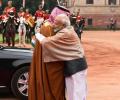
'The most unfortunate part is that after precipitating the crisis situation on Tuesday, the government ducked and took help from Saudi Arabia and the UAE to 'de-escalate' the situation.' 'Make no mistake, this fateful move has grave implications.' 'You don't take help from the wolf to guard the sheep, right?' says Ambassador M K Bhadrakumar.

King Salman and Narendra Modi will find common ground to intensify cooperation against jihadi terrorism, says Tarun Vijay, MP.

Everything about ISIS had indicated that this would be a violent Ramzan. A violent, divisive Ramzan sends out exactly the message that ISIS wants to send to religious Muslims outside its folds: It plays on their faith and fears, says writer Tabish Khair.
We should be prepared for a phase of increased tensions in India-Pakistan relationship thanks to the evolving situation in Afghanistan, says Shyam Saran.

Hein Kiessling has the kind of access in Pakistan that journalists (and spies) would die for, says Kanika Datta.

'Nobody knows what they teach in madrasas.' 'If we do not adapt to the ways of the modern world, how will we progress as a community?' 'How will these children compete in the modern world?'

'Pakistan needs to be constantly at war with somebody, ultimately resulting in it waging war on itself and its own people,' says Shekhar Gupta.

'We could crack IM modules in the country because one arrested member would spill beans on the other.' 'With ISIS, every module is different and is possibly being handled by different operators abroad.'
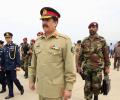
'This army has lost Pakistan's territory, ideology, financial and intellectual capital, ruined its institutions, democracy, the respect for its passport and, like it or not, reduced its status to a globally acknowledged university of jihad,' says Shekhar Gupta.
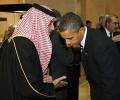
Further deterioration of the US-Saudi relationship will have geo-economic and geopolitical effects, says Nitin Pai.
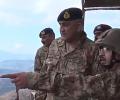
'The Pakistani military has encouraged and supported terrorist organisations, especially in Kashmir, as a means of waging proxy war against the Indian military and the country's superior economic resources.' 'The evidence is irrefutable with the recent killing of 46 paramilitary troops being just the latest example.'

Any attempt to defang Islamic State must first cut off its main sources of funding, especially its revenue from oil sales, extortion and crime, ransom payments, and support from foreign donors. This will also be need to be backed up by efficient forces on the ground.

Global working conditions have worsened in 2014.

The number of people killed in acts of terror reached a record high last year, with almost four in five of these deaths occurring in just five countries, new research shows.
